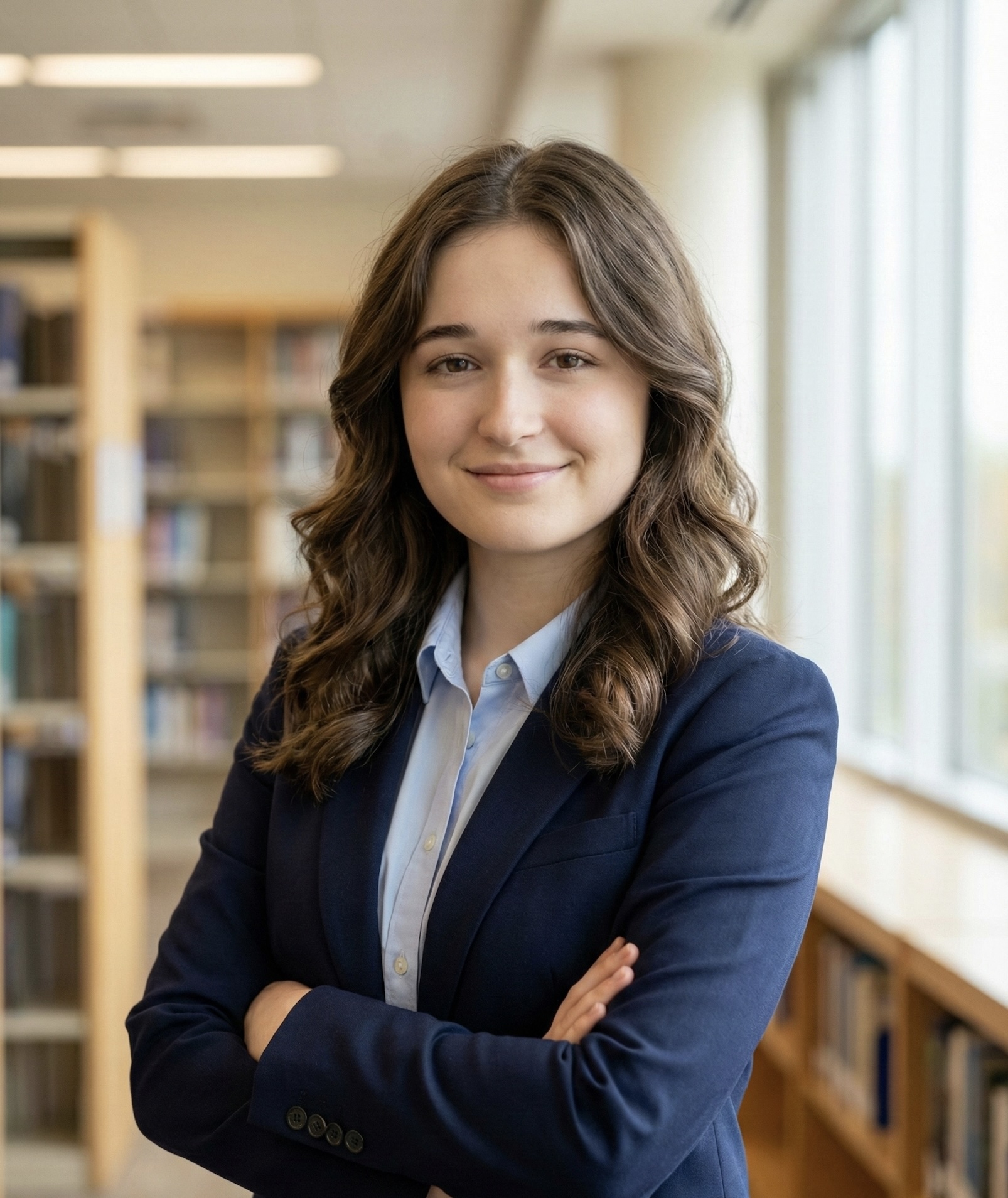
A Bridge Between Science & Storytelling
As a student at Robert College, my academic journey continues with a GPA above 96. I will likely graduate with 16 AP courses. But I don't see myself as just an academic; I am also a curious explorer of the human condition.
My passion lies at the intersection of Neuroscience and Literature. As a curious student, I believe that every neural pathway tells a story, and every story has a biological basis. I don't just want to study the brain in the lab; I want to understand how it shapes the complex narratives of our lives.
Whether I'm analyzing a complex synapse in Biology or staging a modern dance performance, I'm driven by the same goal: to translate the complex languages of science into compelling human stories that everyone can understand.
The Ultimate Frontier
Humanity has explored space, delved into the depths of the atom, but still hasn't fully unraveled the 1.5-kilogram structure we carry on our shoulders. What draws me to neuroscience is that the most complex structure in the universe is trying to understand itself.
As a curious student, I question why characters make certain decisions, while as an aspiring scientist, I want to see the neuronal firings and synaptic connections behind those decisions.
Science & Humanity
Neuroscience is not just about the laboratory; it lies at the very heart of psychology, philosophy, artificial intelligence, and medicine. It is the bridge between the abstract 'mind' and the concrete 'brain'.
Being able to explain why a person empathizes, falls in love, or is afraid — not just with words but with neurotransmitter levels — is the most poetic aspect of science.
Social Impact
The increasing number of neurodegenerative diseases and mental health problems worldwide makes every research project in this field vital.
I want to make neuroscience more understandable by combining complex scientific data with the narrative power of a writer, and to be a part of the solutions in this field.
The brain is the only organ that carries our entire past, future, and who we are. Understanding it is like deciphering the codes of life.
It's the only field that combines the precision of biology with the depth of psychology. I like analyzing the brain as if I were analyzing a complex story.
In an age where artificial intelligence attempts to mimic the human mind, I believe we cannot build the future without understanding its true source — the human brain.
Academic Standing
Turkey Rank: 1st Place — Perfect score of 500/500
Scholarship and boarding student, representing Nevşehir as the first student to achieve this distinction
Ranked 1st throughout grades 5, 6, 7, and 8 at Altınyıldız College
Intellectual Competitions & Global Rankings
Advanced Placement Portfolio
Target: 16 AP courses by graduation
| Course | Status |
|---|---|
| AP Biology & AP Seminar | In Progress — Robert College — May 2026 |
| AP Statistics, Psychology, Environmental Science | In Progress — Independent Study — May 2026 |
| AP Physics C (Mech & EM), Calculus BC, Chemistry, English Language and Composition | Planned — 2026–2027 |
| AP Research, English Literature and Composition, Art History, Macroeconomics, Microeconomics, Computer Science | Planned — 2027–2028 |
Koç University — High School Medical School
Graduated with Distinction
Koç University — Molecular Biology & Genetics
Graduated with Honors
Ankara University — Applied Biotechnology
Course for High School Students
Acıbadem University — Summer Science Camp
Medicine & Health Sciences
CERAN Belgium — International Summer School
International academic program
Bridging the Past and Future of the Human Brain
Research commentary by İpek Barış
The Mathematical Language of Life
A quantitative description of membrane current and its application to conduction and excitation in nerve (Hodgkin & Huxley, 1952)
Awards & Recognition
Nobel Prize in Physiology or Medicine (1963). This study is universally regarded as the foundation of modern neurophysiology.
The Significance
By studying the giant axon of a squid, Hodgkin and Huxley decoded how neurons "speak" through electrical impulses.
What I Learned
This study was a revelation in how I perceive the "biological self." It taught me that at our most fundamental level, we are governed by the elegant precision of physics and mathematics. By analyzing the Hodgkin-Huxley model, I realized that a thought is not just an abstract concept; it is a measurable, quantitative event driven by the flux of ions across a membrane. As an aspiring scientist, this taught me the importance of rigorous modeling—the idea that even the most complex human experiences, like a reflex or a memory, have a mathematical signature that can be decoded and understood through the lens of electrophysiology.
Personal Insight
This study was a revelation in how I perceive the "biological self." It taught me that at our most fundamental level, we are governed by the elegant precision of physics and mathematics. By analyzing the Hodgkin-Huxley model, I realized that a thought is not just an abstract concept; it is a measurable, quantitative event driven by the flux of ions across a membrane.
The Takeaway
As an aspiring scientist, this taught me the importance of rigorous modeling—the idea that even the most complex human experiences have a mathematical signature that can be decoded through the lens of electrophysiology.
The Specialized Map of Identity
The fusiform face area: a module in human extrastriate cortex specialized for face perception (Kanwisher et al., 1997)
Awards & Recognition
Lasker Award (2024) and the Kavli Prize in Neuroscience (2022). Dr. Nancy Kanwisher was recognized for her transformative role in cognitive neuroscience.
The Significance
This research identified a specific region in the brain—the Fusiform Face Area (FFA)—dedicated solely to recognizing faces.
What I Learned
This research deepened my understanding of the "modular brain." It taught me that the human brain has evolved highly specialized "tools" for our most critical survival needs—social connectivity. As someone passionate about literature and character development, learning about the Fusiform Face Area (FFA) was fascinating; it provided the biological "why" behind our innate ability to read emotions and recognize identity. It taught me that our cognitive architecture is not a general-purpose processor, but a masterpiece of evolutionary specialization, where certain neural real estate is so valuable that it is dedicated solely to the art of human recognition.
Personal Insight
This research deepened my understanding of the "modular brain." It taught me that the human brain has evolved highly specialized "tools" for our most critical survival needs: social connectivity. As someone passionate about literature and character development, learning about the Fusiform Face Area (FFA) provided the biological "why" behind our innate ability to read emotions.
The Takeaway
It taught me that our cognitive architecture is not a general-purpose processor, but a masterpiece of evolutionary specialization, where certain neural real estate is dedicated solely to the art of human recognition.
The Digital Blueprint of the Mind
A petavoxel fragment of human cerebral cortex reconstructed at nanoscale resolution (Lichtman & Google, 2024)
Awards & Recognition
While too recent for a Nobel, this study has received global acclaim, including Science Magazine's "Breakthrough of the Year" considerations and features in Nature.
The Significance
Researchers mapped a tiny fragment of the human cortex in 3D, revealing 150 million synapses in unprecedented detail.
What I Learned
Engaging with this petavoxel reconstruction taught me about the scale of human complexity. It shifted my perspective from seeing the brain as a collection of regions to seeing it as a "Connectome"—an unimaginably dense forest of 150 million synapses in just a tiny sliver of tissue. This study taught me that the future of neuroscience is inherently interdisciplinary. It showed me that to solve the mysteries of the mind, we must bridge the gap between "wet lab" biology and high-performance computational science. It inspired me to think about how we can manage and interpret such massive datasets to find the "rules" of neural connectivity.
Personal Insight
Engaging with this petavoxel reconstruction taught me about the staggering scale of human complexity. It shifted my perspective from seeing the brain as a collection of regions to seeing it as a "Connectome"—an unimaginably dense forest of 150 million synapses in just a tiny sliver of tissue.
The Takeaway
This study taught me that the future of neuroscience is inherently interdisciplinary. It showed me that to solve the mysteries of the mind, we must bridge the gap between "wet lab" biology and high-performance computational science.
Decoding Intent: The Power of Thought
High-performance brain-to-text communication via handwriting (Willett et al., 2021)
Awards & Recognition
Nature's 10 (Scientific Breakthroughs) and the Brain Prize (Lundbeck Foundation) nominations for its impact on neuroprosthetics.
The Significance
This represents the frontier of Brain-Computer Interfaces (BCI), allowing individuals to "type" simply by imagining handwriting.
What I Learned
This study was perhaps the most emotionally and intellectually resonant for me. It taught me that the brain's plasticity and its ability to interface with technology represent the ultimate triumph of human empathy. I learned how neural signatures of a simple action—like imagining handwriting—can be bypassed and translated into digital text. As a curious student, this struck a chord: it taught me that our "voice" is not limited to our vocal cords or our hands; it resides in our neural intent. This research solidified my commitment to Biomedical Engineering, teaching me that the highest purpose of neuroscience is to restore the human connection and autonomy that disease or injury has taken away.
Personal Insight
This study represents the ultimate triumph of human empathy. I learned how neural signatures of a simple action—like imagining handwriting—can be bypassed and translated into digital text. As a curious student, this struck a chord; it taught me that our "voice" is not limited to our vocal cords; it resides in our neural intent.
The Takeaway
This research solidified my commitment to Biomedical Engineering, teaching me that the highest purpose of neuroscience is to restore the human connection and autonomy that disease or injury has taken away.
Debate
Active member of the Robert College Debate Club. Participated in 3 international competitions (Zagreb–WHO, Istanbul–ESDC, Copenhagen–NSDC) and 6 national competitions.
Modern Dance
One of only two 10th-grade students selected for active performance roles in the Robert College Modern Dance Club.
Neuroscience
Dedicated member of the Robert College Neuroscience Club, bridging scientific inquiry with creative exploration.